
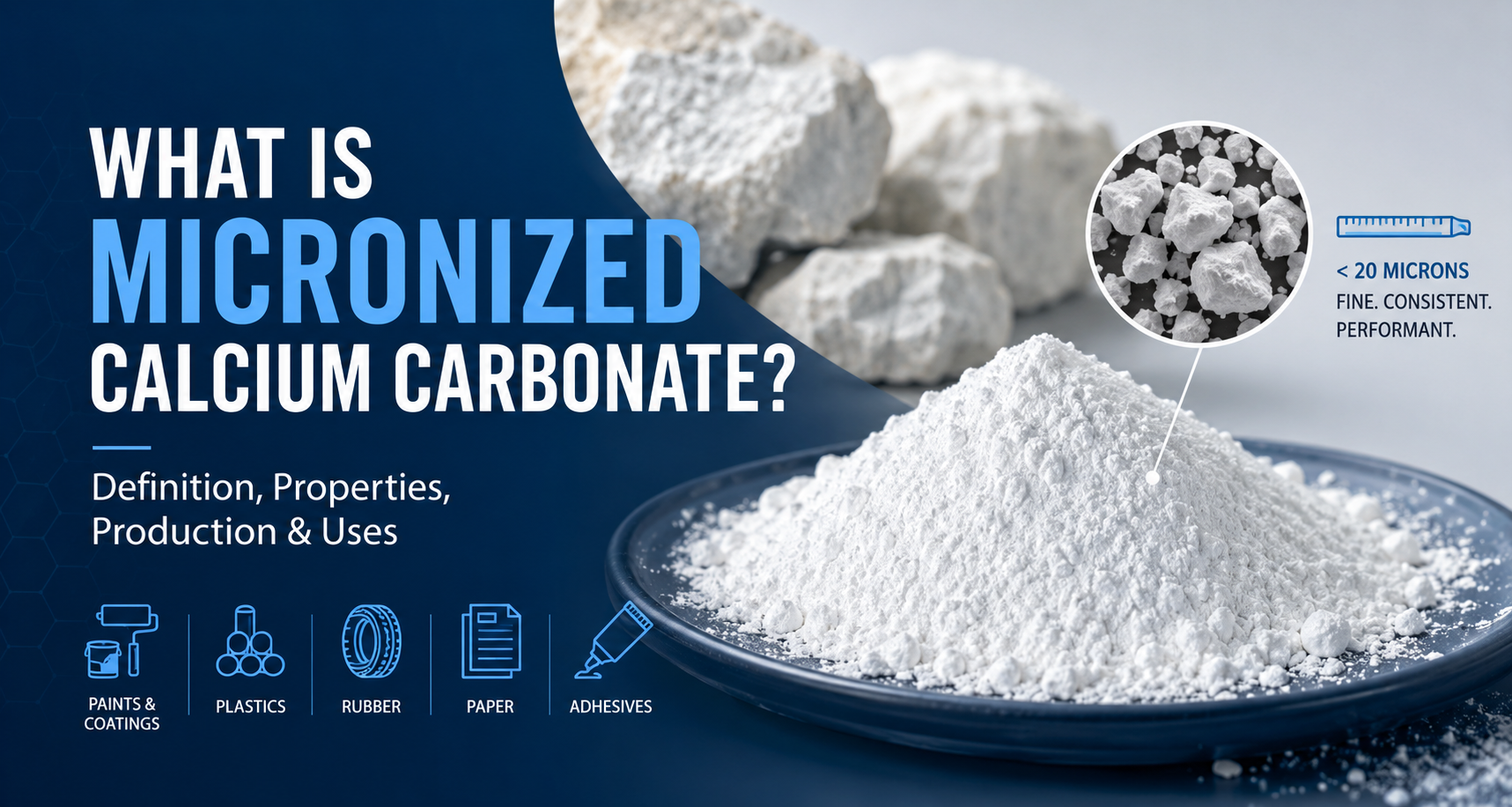
So, what is micronized calcium carbonate? In plain terms, it’s calcium carbonate (CaCO3) that has been ground down to an extremely fine, tightly controlled particle size, typically in the micron range, often below 10 microns and sometimes into the sub-micron scale. It’s the same mineral compound found in limestone, chalk, and marble, just processed to a much finer and more consistent powder than standard ground calcium carbonate.
This finer particle size isn’t just about being “more crushed.” Micronization changes how the material behaves: it disperses more easily, packs more densely, and interacts differently with other ingredients in a formulation. That’s why industries select micronized CaCO3 specifically for more demanding applications, rather than simply defaulting to the standard ground version.
How Micronized Calcium Carbonate Is Produced
Production starts with natural limestone or marble, which is crushed into smaller fragments. These fragments then go through fine milling, typically in a ball mill or jet mill, to break the particles down further. After milling, the material passes through air classification, a process that separates particles by size and sieves out anything coarser than the target range. This step is repeated as needed until the desired fineness is reached. The result is a powder with a narrow, controlled particle size distribution rather than a mix of fine and coarse grains.
What “Micronized” Actually Means
The micronized CaCO3 meaning comes down to particle size: material ground fine enough that most particles measure under 20 microns, with many products reaching well below that. To put that in perspective, a single human hair is roughly 50 to 70 microns wide, so micronized calcium carbonate particles are several times finer than something already too small to see clearly with the naked eye. In the industry, this fineness is often expressed using mesh sizing rather than micron measurements alone, for example mesh 1250 or mesh 2500, which are common examples of micronized grades. The exact specifications and mesh-to-micron breakdowns vary by supplier and application, but the core idea behind the micronized calcium carbonate definition stays consistent: significantly finer and more uniform than standard ground calcium carbonate.
Properties That Define It
Micronized calcium carbonate is known for a few defining properties. It typically has high whiteness, with many micronized grades reaching 94% or higher GE brightness, which makes it useful in applications where color consistency matters. Particle size is tightly controlled, generally with a D97 value of 20 microns or below, meaning at least 97% of the particles fall under that size. It’s also chemically inert, meaning it doesn’t react with most other substances, so it can be added to a formulation without altering its chemical stability. Because it’s produced from high-purity calcium carbonate sources, it offers reliable quality, though exact purity levels vary by grade and supplier. Finally, it has an even particle size distribution, which means the material behaves predictably and consistently from batch to batch, rather than varying in fineness.
Industries That Rely on It
In paints and coatings, it’s used as a filler that helps control gloss and consistency without affecting color. In plastics, it adds bulk and improves stiffness while keeping production costs down. In rubber manufacturing, it serves as a reinforcing filler that helps maintain product structure. In paper production, it’s used to improve brightness and opacity in the final sheet. In adhesives, it helps adjust viscosity and improves the overall consistency of the bond. Across all of these industries, the appeal is the same: a fine, predictable material that performs reliably batch after batch.
Micronized vs. Standard Calcium Carbonate
The main difference between the two comes down to particle size and consistency. Standard ground calcium carbonate has larger, less uniform particles, which makes it well suited for bulk applications like construction materials, where fine finish isn’t a priority. It’s typically less expensive to produce as a result, since it requires less processing. Micronized calcium carbonate, on the other hand, is processed to a much finer and more consistent particle size, which makes it better suited for applications where performance, texture, or finish actually matter. In short, if the end product needs to look smooth, blend evenly, or perform with precision, micronized is usually the better fit. If it just needs bulk and basic structure, standard ground calcium carbonate often does the job at a lower cost.
FAQ
What does “micronized” mean in calcium carbonate?
“Micronized” refers to a fine grinding process that reduces calcium carbonate particles down to the micron scale, typically below 20 microns. This results in a finer, more uniform powder than standard grinding methods produce.
Is micronized calcium carbonate the same as ground calcium carbonate (GCC)?
Not exactly. Micronized calcium carbonate is a subset of ground calcium carbonate, but it’s processed further to achieve a much finer and more tightly controlled particle size than standard GCC.
What particle size counts as micronized?
There’s no single universal cutoff, but particles under 20 microns are generally considered micronized, with many products reaching well below 10 microns or even into the sub-micron range. The exact threshold can vary slightly depending on the supplier and industry standard.
What industries use micronized calcium carbonate the most?
Paints and coatings, plastics, rubber, paper, and adhesives are among the heaviest users, since these industries rely on fine, consistent particles for performance and finish. Each industry uses it for slightly different reasons, ranging from color consistency to structural reinforcement.
Where to Go From Here
Now that you know what micronized calcium carbonate is, you can better evaluate whether it’s the right material for your specific application. For detailed technical specifications, particle size options, and available grades, visit our Calcium Carbonate grades product page.