
Talc is one of the most widely used industrial minerals, but not all talc powder is the same. When you’re sourcing it for paints, plastics, rubber, or construction materials, the right choice depends on three things: color, particle size (grade), and how the talc was processed. Understanding these types of talc powder before you request samples or quotes saves time, narrows the conversation with your supplier, and helps you land on the right specification the first time instead of going back and forth on revised quotes. This guide breaks down each classification so you can identify what your application actually needs and walk into a sourcing conversation already speaking the right technical language.
Classification by Color: White vs. Grey Talc
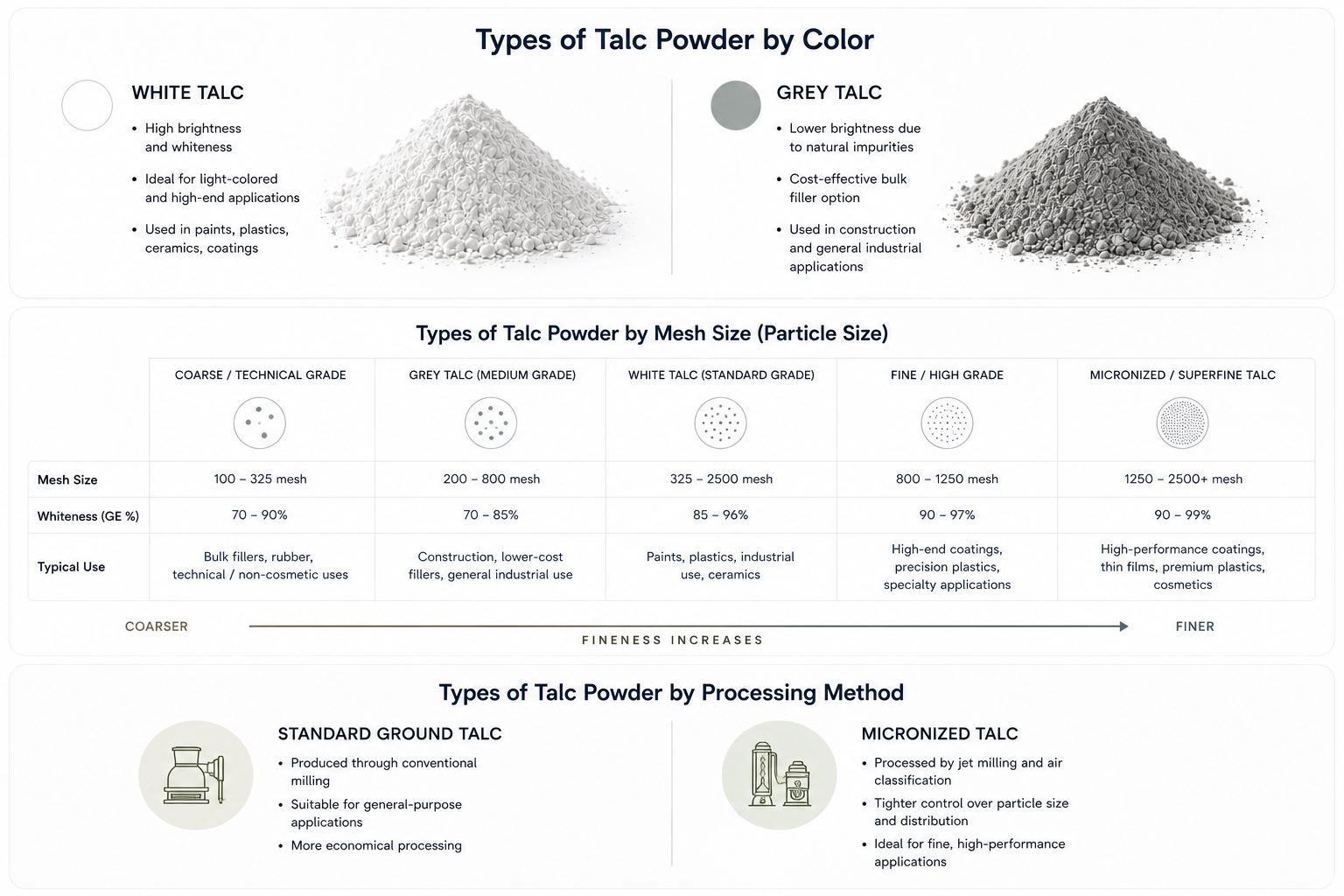
The first way talc is classified is by color, and this comes down to geology, not manufacturing. Color variation in talc results from naturally associated minerals (things like iron oxides, chlorite, magnesite, and dolomite) that occur alongside the talc deposit itself, rather than from anything done during processing. In other words, no amount of milling or refining turns grey talc white; the color is set by what’s in the ore body before it ever reaches a mill.
White talc has higher whiteness and brightness, which makes it the go-to choice where visual appearance matters: coatings, plastics, ceramics, and other light-colored end products where any tint would show through in the final color or finish. Grey talc has lower brightness due to those naturally occurring impurities, and it’s commonly used in applications where color isn’t a deciding factor. Construction materials and general industrial fillers are good examples, where it tends to be a more cost-effective bulk option precisely because brightness isn’t part of the spec.
It’s worth being clear on one point: grey talc is not a “lower quality” product. It’s a different fit for different uses, not an inferior version of white talc. If your application doesn’t depend on brightness, grey talc can do the job just as effectively while keeping material costs down. Choosing it isn’t a compromise, it’s matching the material to the actual requirement.
Classification by Particle Size: Understanding Talc Mesh Sizes
Beyond color, talc is also classified by particle size, commonly referred to as mesh size. This is the standard way the industry measures how fine or coarse a talc powder is: the higher the mesh number, the finer the particles. It’s the single most useful number to know when comparing suppliers, since it tells you directly whether a grade will behave like a coarse bulk filler or a fine, high-performance additive. Talc itself is a magnesium silicate (Mg3Si4O10(OH)2), and that basic mineral structure stays the same across every grade. What changes from one grade to the next is purely how finely it’s been milled and classified.
This range runs from coarse, technical-grade material on one end to micronized, superfine talc on the other:
|
Type |
Mesh / Particle Size | Whiteness (GE %) | Typical Use |
|---|---|---|---|
| White talc | 325–2500 mesh | 85–96% |
Paints, plastics, industrial use, ceramics |
|
Grey talc |
200–800 mesh | 70–85% | Construction, lower-cost fillers, general industrial use |
| Micronized/superfine talc | 1250–2500+ mesh | 90–99% |
High-end coatings, thin films, precision plastics |
|
Coarse/technical grade |
100–325 mesh | 70–90% |
Bulk fillers, rubber, technical/non-cosmetic uses |
As a general rule, finer grades cost more, since reaching a higher mesh number requires additional milling and classification steps. Coarser grades are simpler to produce and tend to be more economical for applications that don’t need fine particle control.
Classification by Processing Method
The third way to classify talc powder types is by how the material is processed. Standard ground or milled talc is produced through conventional grinding, which works well for many general-purpose applications and is generally the more economical processing route. Micronized talc, on the other hand, goes through additional steps, typically jet milling combined with air classification, to achieve tighter, more consistent control over particle size distribution. This makes micronized talc the standard choice when an application calls for very fine, uniform particles, since standard grinding alone can’t reliably hit the same level of consistency at the finer end of the mesh range.
Some talc grades are also surface-treated or coated to improve how they perform in specific formulations, such as dispersion or compatibility with certain polymers. That’s a more specialized topic on its own, so we won’t go into detail here. Just know that treated grades exist alongside the standard and micronized types if your application has particular performance requirements your standard grade isn’t meeting.
Matching Talc Type to Industrial Use
With color, mesh size, and processing method covered, here’s a practical reference for how these types of talc powder typically map to common industries. This isn’t a deep technical breakdown, just enough to point you toward the right category before you get into exact specifications.
Paints and coatings: Finer, higher-whiteness grades are generally preferred, since particle size affects gloss and finish while color affects the final shade of light-colored formulations.
Plastics: Talc is used as a filler to improve rigidity and dimensional stability, with grade selection depending on whether appearance or pure functional performance is the priority for the finished part.
Rubber: Coarser, technical-grade talc is common here, valued for its cost-effectiveness and functional contribution rather than appearance, since rubber compounds rarely depend on the filler’s brightness.
Ceramics: White, finer-grade talc is typically used to support a clean, consistent finish in the final product, particularly where the talc contributes to the visible surface.
Construction: Grey talc and coarser grades are widely used as economical fillers, where color and ultra-fine particle size aren’t priorities and bulk cost-efficiency matters more.
For detailed technical specifications and grade options, see our full guide to industrial talc powder.
A Quick Note on White vs. Grey Talc
You may already be narrowing your decision down to one specific question: white or grey? That’s a common point where buyers get stuck, and it deserves more depth than an overview article can give it. If your main decision is specifically between white and grey talc, including which grade to order, what the cost difference means, and which fits your application, we cover that in detail in our dedicated comparison guide of White Talc vs Grey Talc.
FAQ
What are the main types of talc powder used in industry?
Talc powder is generally classified three ways: by color (white or grey), by particle size or mesh grade (from coarse to micronized), and by processing method (standard ground vs. micronized). Most buyers narrow down which types of talc powder fit their application using a combination of all three, rather than relying on just one factor.
What does mesh size mean for talc powder?
Mesh size indicates particle fineness. The higher the mesh number, the finer the powder. It ranges from coarse technical grades around 100–325 mesh up to micronized, superfine grades above 2500 mesh, with cost generally increasing alongside fineness due to the extra processing involved.
Which type of talc is used in plastics and rubber?
Plastics typically use talc as a reinforcing filler, with grade choice depending on whether appearance matters for the end product. Rubber applications commonly use coarser, technical-grade talc, since cost-effectiveness and function take priority over brightness in most rubber compounds.
What is the difference between standard ground talc and micronized talc?
Standard ground talc is produced through conventional milling and suits general-purpose use where particle size control doesn’t need to be exact. Micronized talc adds jet milling and air classification for much tighter control over particle size, making it the choice for applications needing very fine, consistent particles.
Ready to Choose Your Grade?
Narm Powder supplies both white and grey talc across multiple mesh grades, from coarse technical material to micronized superfine powder. Ready to choose your grade? Visit our talc product page for full specifications, or go directly to our grey talc page if you’ve already identified your type.