
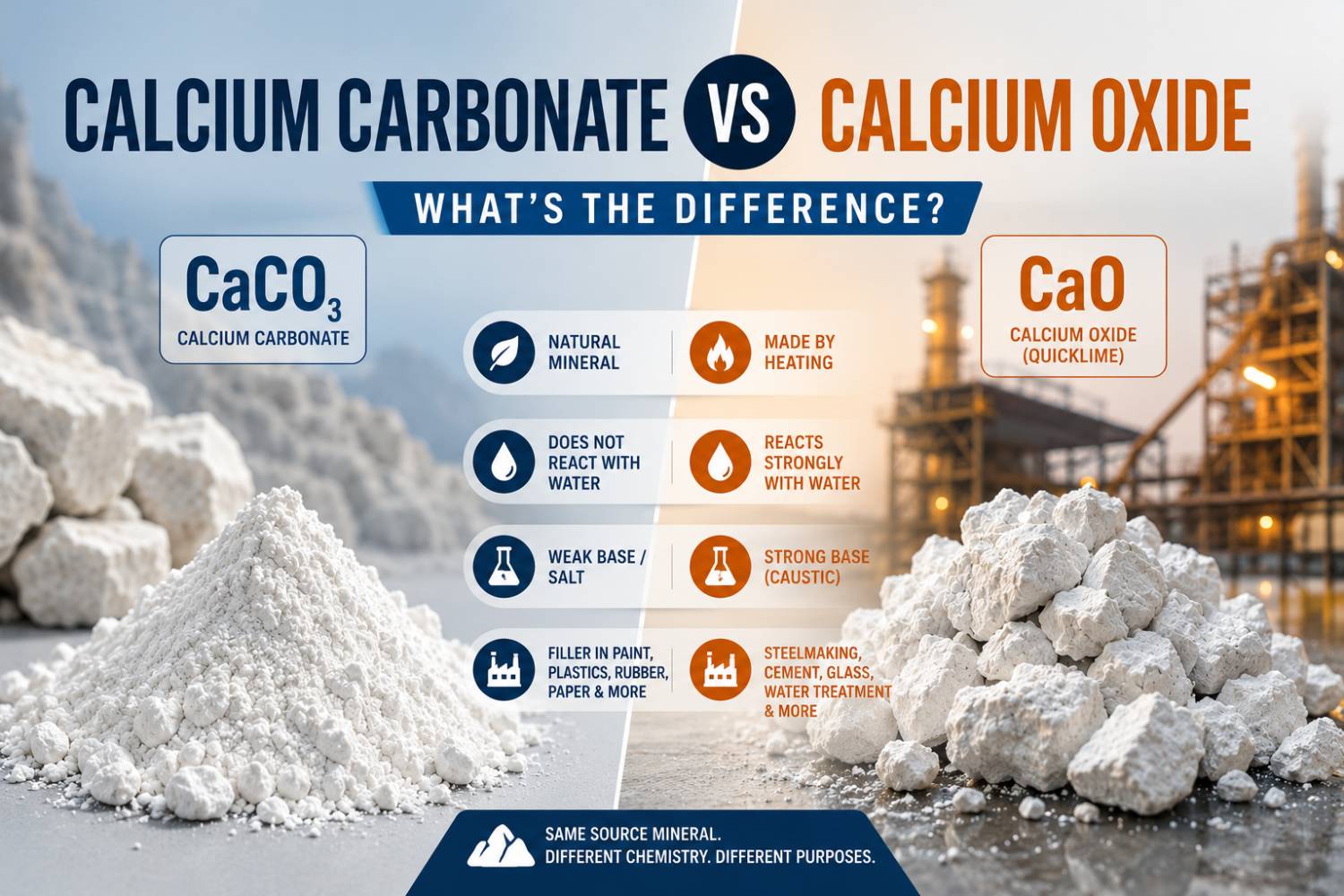
Calcium carbonate and calcium oxide are two different compounds that are easy to mix up, but chemically, they’re not the same thing at all. Calcium carbonate (CaCO₃) is the natural mineral form found in limestone, chalk, and marble. Calcium oxide (CaO) is what you get after heating calcium carbonate to a very high temperature, driving off carbon dioxide in the process. One is mined; the other is made. Understanding the difference between calcium carbonate vs calcium oxide matters whenever you’re specifying a material, since ordering the wrong one can mean ordering the wrong product entirely.
Calcium Carbonate vs Calcium Oxide at a Glance
Before getting into the details, it helps to see the two side by side. The table below sums up CaCO3 vs CaO across composition, how each one forms, how reactive it is, and what it’s typically used for.
|
Property |
Calcium Carbonate (CaCO₃) | Calcium Oxide (CaO) |
|
Common name |
Limestone, chalk, marble | Quicklime, burnt lime |
| Composition | Calcium, carbon, oxygen |
Calcium, oxygen only |
|
Formed by |
Natural mineral (mined directly) | Heating CaCO₃ above ~840°C (calcination) |
| Reaction with water | Insoluble, does not react |
Reacts strongly, forms calcium hydroxide |
|
Reaction with acid |
Reacts, releases CO₂ gas | Reacts vigorously, forms calcium chloride + water |
| Chemical nature | Weak base / salt |
Strong base (caustic) |
| Typical industrial use | Filler in paint, plastics, rubber, paper |
Steel making, cement, glass, water treatment |
How Calcium Oxide Is Made From Calcium Carbonate
Calcium oxide doesn’t occur as its own mineral in nature, it’s produced by heating calcium carbonate. When CaCO₃ is heated above roughly 840°C, it breaks down into calcium oxide and carbon dioxide gas.
This process is called calcination, and industrially it happens inside a lime kiln, where crushed limestone is heated continuously and the CO₂ escapes as a gas while solid calcium oxide remains behind. In simple terms: limestone goes in, quicklime comes out, and carbon dioxide is released along the way. It’s a transformation, not a different mineral, the same calcium atoms end up in a new chemical form.
Key Behavioral Differences Between CaCO₃ and CaO
The most important practical difference between calcium carbonate and calcium oxide is how each one behaves around water. Calcium carbonate is insoluble and simply does not react with water, you can get it wet with no incident. Calcium oxide is the opposite: it reacts strongly with water to form calcium hydroxide (slaked lime), and that reaction releases a noticeable amount of heat. This is a real safety and handling distinction, since quicklime needs to be stored and handled with that reactivity in mind.
Both compounds react with acid, but not in the same way. Calcium carbonate reacts with acid and releases CO₂ gas, visible as fizzing or bubbling (this reaction is covered in more depth in our separate article on calcium carbonate’s reaction with acids). Calcium oxide reacts with acid too, but more vigorously, forming calcium chloride and water.
Stability is another point of contrast. Calcium carbonate is stable at room temperature and can sit on a shelf indefinitely without changing. Calcium oxide is more reactive: if it isn’t stored properly, it will slowly pull moisture and CO₂ out of the air over time, gradually converting back toward carbonate or hydroxide forms.
Where Each One Is Actually Used
Despite coming from the same source mineral, calcium carbonate and calcium oxide serve almost entirely different industrial purposes. Calcium carbonate is widely used as a filler in paints, plastics, rubber, and paper, and it’s also a common construction material. It shows up in everyday life too, antacid tablets are a familiar example of a product built around calcium carbonate, though that’s just a recognizable reference point and not a claim about any specific use.
Calcium oxide, on the other hand, is a workhorse in heavy industry: it’s used in steel manufacturing, cement production, glass manufacturing, water treatment, and flue-gas desulfurization. If you’re sourcing material for filler or construction applications, you almost certainly want calcium carbonate. If you’re working in steelmaking, cement, or water treatment, calcium oxide is the relevant compound. Neither one is better than the other, they simply solve different problems.
Common Mix-Ups to Avoid
The biggest source of confusion is the word “lime” itself, which gets used loosely to mean either compound. The difference between limestone and quicklime comes down to this: quicklime refers specifically to calcium oxide (CaO), while limestone refers to calcium carbonate (CaCO₃). They are not interchangeable terms, even though everyday language sometimes treats them that way. If you’re specifying a material for a technical or industrial purpose, simply asking for “lime” without clarifying which compound you mean can result in receiving the wrong material entirely, which matters given how differently CaCO₃ and CaO behave once they’re in front of you.
FAQ: Calcium Carbonate vs Calcium Oxide
Is calcium carbonate the same as quicklime?
No. Quicklime is calcium oxide (CaO), while calcium carbonate (CaCO₃) is limestone. They’re related, quicklime is made from limestone, but they are different compounds with different properties.
What happens when you heat calcium carbonate?
When calcium carbonate is heated above approximately 840°C, it undergoes calcination: it breaks down into calcium oxide and releases carbon dioxide gas. This is how quicklime is produced industrially in a lime kiln.
Which one reacts with water, CaCO₃ or CaO?
Calcium oxide reacts strongly with water, forming calcium hydroxide and releasing heat. Calcium carbonate is insoluble and does not react with water at all.
Which one is used as a filler in plastics and paint?
Calcium carbonate (CaCO₃) is the one used as a filler in plastics, paint, rubber, and paper. Calcium oxide is used in entirely different applications, such as steelmaking and cement production.
Looking for Calcium Carbonate?
To be clear, Narm Powder supplies calcium carbonate (CaCO₃), not calcium oxide, across a range of industrial grades. If calcium carbonate is the material you’re after, you can find full specifications or request a sample on our Calcium Carbonate product page.