
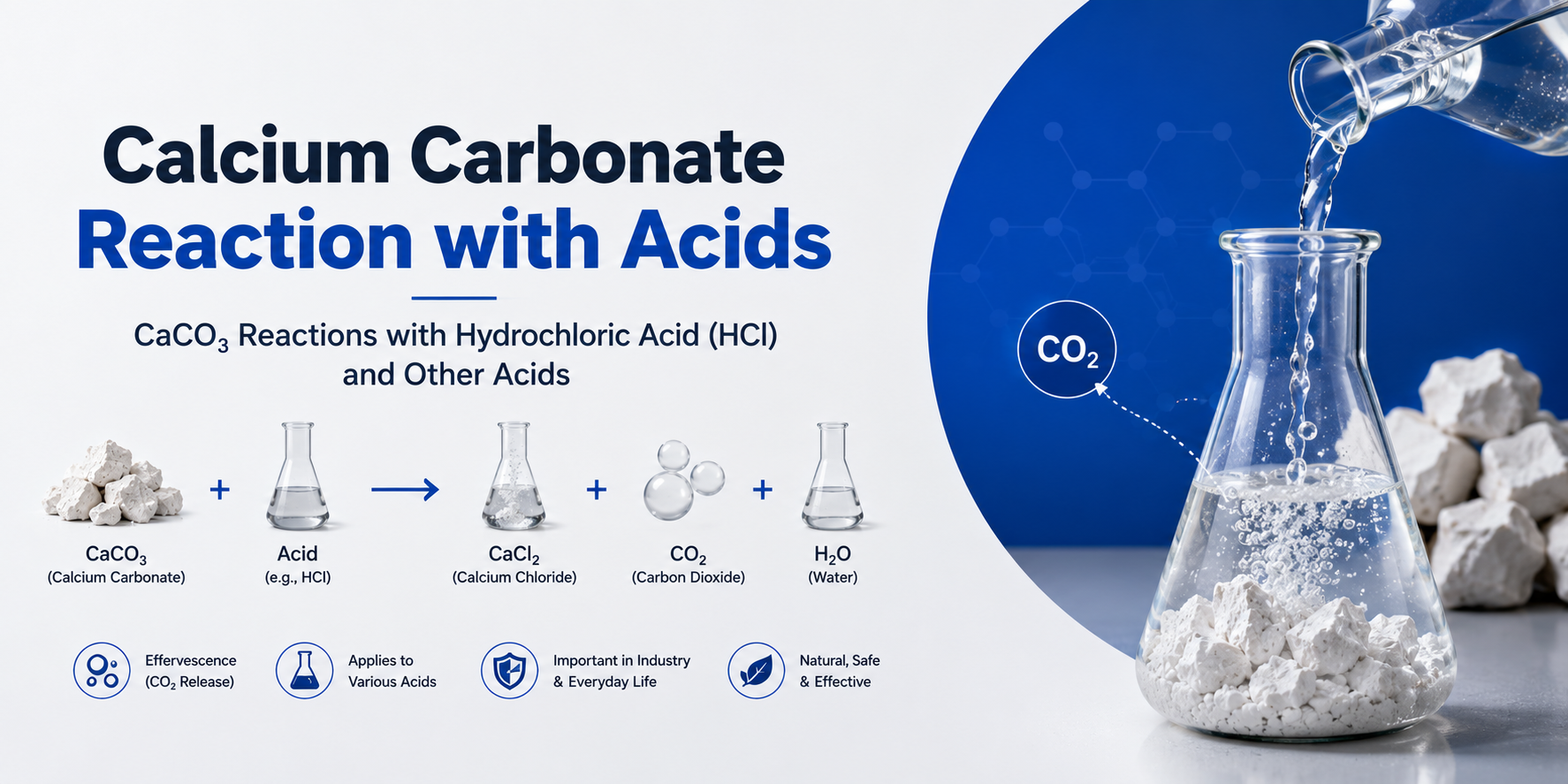
Have you ever noticed limestone or chalk fizzing when it comes into contact with vinegar? This simple yet important phenomenon, forms the basis of the reaction between calcium carbonate and various acids. Geologists, chemists, and chemical engineers alike rely on this reaction for mineral identification, raw material processing, and even industrial surface cleaning applications.
In this article, we will explore what causes calcium carbonate to react with acids, the factors that influence the reaction rate, and why hydrochloric acid (HCl) is the most widely used acid for calcium carbonate testing and industrial applications
Why Does Calcium Carbonate React with Acids?
Calcium carbonate is a carbonate salt composed of calcium ions (Ca²⁺) and carbonate ions (CO₃²⁻). In an acidic environment, hydrogen ions (H⁺) react with the carbonate ions, converting them into carbonic acid (H₂CO₃). However, carbonic acid is inherently unstable and rapidly decomposes into water (H₂O) and carbon dioxide (CO₂). The release of carbon dioxide gas is responsible for the characteristic bubbling and effervescence observed during the reaction.
In simple terms, the more acidic the environment, the faster the carbonate ions become unstable and react. As a result, the type of acid, its concentration, and the reaction temperature are three key factors that determine the rate and intensity of the calcium carbonate–acid reaction.
Calcium Carbonate Reaction with Hydrochloric Acid (HCl)
The reaction between calcium carbonate and hydrochloric acid (HCl) is one of the most well-known reactions in inorganic chemistry. Often referred to simply as the calcium carbonate–HCl reaction, it is widely used in laboratory analysis, mineral identification, and various industrial processes. The reaction can be represented by the following chemical equation:
CaCO₃ (solid) + 2HCl (aqueous) → CaCl₂ (aqueous) + H₂O (liquid) + CO₂ (gas)
In this process, calcium chloride (CaCl₂), water (H₂O), and carbon dioxide gas (CO₂) are produced. Calcium chloride is highly soluble in water, meaning that no solid residue remains once the reaction is complete. This characteristic makes hydrochloric acid (HCl) an ideal choice for removing limescale, cleaning carbonate-based deposits, and dissolving calcium carbonate residues in industrial and maintenance applications.
What makes hydrochloric acid (HCl) the preferred choice for calcium carbonate reactions?
Several factors make hydrochloric acid (HCl) the preferred acid for reacting with calcium carbonate:
- Fast Reaction Rate: Due to its strong acidic nature, the reaction proceeds rapidly and can be completed at room temperature.
- Relatively Safe Reaction Products: The main products, calcium chloride (CaCl₂) and water, are relatively easy to handle and dispose of in accordance with applicable regulations.
- Wide Availability and Cost-Effectiveness: Hydrochloric acid is one of the most readily available and economical strong acids used in industrial and laboratory applications.
- No Protective Surface Layer Formation: Unlike sulfuric acid, hydrochloric acid produces calcium chloride (CaCl₂), which remains dissolved in solution. As a result, no insoluble layer forms on the surface of the calcium carbonate particles, allowing the reaction to continue until the material is fully consumed.
How Calcium Carbonate Reacts with Different Acids
|
Type of Acid |
Reaction Intensity | Main Products | Key Point |
| Hydrochloric Acid (HCl) | Very High | CaCl₂ + H₂O + CO₂ |
Completely Soluble Products, No Precipitate Formation |
|
Sulfuric Acid (H₂SO₄) |
Moderate | CaSO₄ (precipitate) + H₂O + CO₂ | Formation of a Protective Calcium Sulfate Layer Slows the Reaction |
| Nitric Acid (HNO₃) | High | Ca(NO₃)₂ + H₂O + CO₂ |
Soluble Calcium Nitrate Formation and Rapid Reaction Rate |
|
Acetic Acid (CH₃COOH) |
Low to Moderate | Ca(CH₃COO)₂ + H₂O + CO₂ |
Weak Acid with a Slow, Gradual Reaction |
As shown above, the reaction between calcium carbonate and sulfuric acid differs from reactions with most other acids. The calcium sulfate (CaSO₄) produced is only sparingly soluble and forms a layer on the surface of the calcium carbonate particles. This layer acts as a barrier, slowing further contact between the acid and the carbonate and consequently reducing the reaction rate. For this reason, sulfuric acid (H₂SO₄) is generally not the preferred choice when complete dissolution of calcium carbonate is required in industrial applications.
Calcium Carbonate Reaction with Acetic Acid (CH₃COOH)
You may have come across the well-known household experiment in which an egg is placed in vinegar and, over time, its shell dissolves, leaving behind a soft, rubber-like membrane. This phenomenon is a direct result of the reaction between calcium carbonate, the primary component of the eggshell, and acetic acid, the active acidic component of vinegar.
Simplified Chemical Equation:
CaCO₃ + 2CH₃COOH → Ca(CH₃COO)₂ + H₂O + CO₂
What Gas Is Released During the Reaction Between Calcium Carbonate and Vinegar?
The gas produced is carbon dioxide (CO₂). This is the same gas responsible for the tiny bubbles that form on the surface of the eggshell during the reaction. Because acetic acid is a weak acid, the reaction proceeds gradually and may take between 24 and 48 hours for the shell to dissolve completely. During this process, the calcium acetate formed remains dissolved in the solution, causing the shell to become progressively thinner.
This simple experiment provides an excellent demonstration of why carbonate compounds are unstable in acidic environments and how they react to release carbon dioxide gas
Applications of Calcium Carbonate Reactions with Acids in Industry
The reaction between calcium carbonate and acids is far more than a laboratory curiosity; it plays a vital role in many industrial applications of calcium carbonate. Some of the most important uses include:
- Limestone Identification: As mentioned earlier, applying a few drops of dilute hydrochloric acid (HCl) to a rock sample will produce rapid effervescence if carbonate minerals are present. This simple field test is widely used in geology and mining for quick carbonate identification.
- Mineral Purity Analysis: By measuring the volume of carbon dioxide (CO₂) released during the reaction, the calcium carbonate content of mineral samples can be determined with reasonable accuracy.
- On-Site CO₂ Generation: In certain small-scale industrial applications, the reaction between hydrochloric acid and calcium carbonate is used to generate carbon dioxide gas for beverage carbonation and other controlled processes.
- Descaling and Equipment Cleaning: Hydrochloric acid is commonly used to remove carbonate-based scale deposits from boilers, pipelines, and heat exchangers, helping maintain operational efficiency and heat transfer performance.
- Calcium Chloride Production: This reaction provides a direct route for producing calcium chloride (CaCl₂), a valuable chemical used in the food industry, pharmaceutical manufacturing, moisture control, and road de-icing applications.
Why Do Geologists Apply Acid to Limestone?
If you encounter an unknown rock in the field and are unsure whether it is limestone or another type of rock, a simple test can provide a quick indication. Applying a drop of 10% hydrochloric acid (HCl) to the rock surface will produce vigorous effervescence if a significant amount of calcium carbonate is present. This fast and cost-effective field method is widely used by geologists and mining professionals as a preliminary identification tool before conducting more detailed laboratory analyses.
What Factors Increase the Rate of the Calcium Carbonate–Acid Reaction?
To achieve a faster calcium carbonate–acid reaction, five key factors must be taken into consideration:
- Particle Size: The finer the calcium carbonate particles, the greater their surface area available for contact with the acid, resulting in a faster reaction. For example, finely ground calcium carbonate powder can react with hydrochloric acid within seconds, whereas a large limestone fragment may require a significantly longer time to dissolve.
- Acid Concentration: Higher acid concentrations provide a greater number of hydrogen ions (H⁺), which increases the reaction rate.
- Temperature: Raising the temperature increases the kinetic energy of the reacting particles, leading to more frequent and effective molecular collisions.
- Agitation and Mixing: Stirring the solution helps prevent reaction products from accumulating on the calcium carbonate surface, allowing fresh acid to continuously contact the material and sustain the reaction.
- Calcium Carbonate Purity: Impurities such as silica, magnesium-containing minerals, and other non-carbonate components can occupy part of the available surface area, reducing the overall reaction rate.
Do All Forms of Calcium Carbonate Exhibit the Same Reaction with Acids?
No. The processing method and surface treatment of calcium carbonate can significantly influence its behavior when exposed to acids. For example, coated calcium carbonate, typically treated with stearic acid, exhibits greater resistance to acid attack than untreated grades. The hydrophobic surface layer acts as a barrier, slowing the penetration of hydrogen ions (H⁺) to the underlying calcium carbonate and consequently reducing the reaction rate.
This characteristic is particularly valuable in applications that require enhanced chemical resistance, such as high-performance plastics, polymer compounds, and other engineered materials where long-term stability is important.
Precipitated Calcium Carbonate (PCC) also tends to exhibit higher reactivity than many naturally occurring calcium carbonate products due to its high purity and uniform particle size distribution. In contrast, natural grades containing clay minerals and other impurities often show lower reaction rates because a portion of the material is non-reactive.
Therefore, when calcium carbonate is intended for use in an acid-based process, an uncoated grade with high fineness and a large specific surface area is generally the most effective choice, providing faster and more complete reaction performance.
Other Important Reactions of Calcium Carbonate: Thermal Decomposition and Interaction with CO₂
Two other important reactions are worth exploring, as they provide a deeper understanding of the chemical behavior and industrial significance of calcium carbonate:
Thermal Decomposition of Calcium Carbonate: At elevated temperatures (typically around 825°C), calcium carbonate decomposes into quicklime (CaO) and carbon dioxide gas (CO₂). This reaction forms the basis of lime production and is one of the most important industrial processes involving calcium carbonate. The reaction can be represented as follows:
CaCO₃ (solid) → CaO (solid) + CO₂ (gas)
This reaction forms the basis of the cement industry and lime (quicklime) production.
Reaction of Calcium Carbonate with Carbon Dioxide:
When CO₂ is passed through limewater (calcium hydroxide solution), calcium carbonate precipitates as a solid. However, in the presence of water and excess CO₂, calcium carbonate can further react to form soluble calcium bicarbonate (Ca(HCO₃)₂). This equilibrium process is responsible for temporary water hardness and also plays a key role in the formation of stalactites and stalagmites in caves.
Conclusion
The reaction of calcium carbonate with acids is a simple yet fundamental process in inorganic chemistry. In this article, we have learned that:
- The primary driving force of the reaction is the interaction between hydrogen ions (H⁺) and carbonate ions (CO₃²⁻), leading to the formation of carbon dioxide (CO₂).
- Hydrochloric acid (HCl) is the most commonly used acid for this reaction due to its fast reaction rate and the formation of fully soluble products.
- The type of acid, particle size, temperature, and purity of calcium carbonate all significantly influence the reaction rate.
- The industrial applications of this reaction are extensive, ranging from limestone identification to descaling processes and calcium chloride (CaCl₂) production.
Now that you are familiar with the details of calcium carbonate reactions with various acids, you can apply this knowledge in the laboratory, in mining operations, or even in simple household experiments. If you have any insights or personal experiences in this area, we would be glad to hear and share them with us.